Gemini · Catamaran
Gemini 105Mc
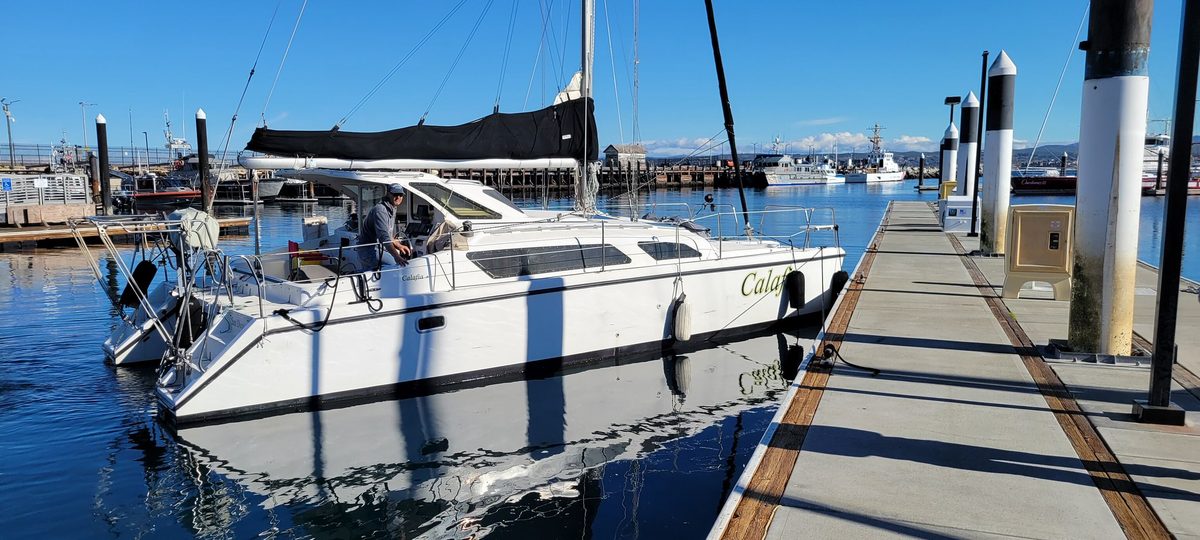
The Gemini 105Mc is a 10.21 m (33 ft 6 in) cruising catamaran by Tony Smith, built by his company Performance Cruising in Annapolis, Maryland; at 4.27 m (14 ft) wide it fits a monohull berth and can go by road. It goes back to the first Gemini of 1981 by way of the 3000, 3200 and 3400: the 105M of 1995 brought new hulls and a new deck, and the 105Mc – Smith sailed one across the Atlantic in June 2001 – a one-piece interior moulding, a cockpit that can be fully enclosed, a mast one foot taller with a crane, a large-roach mainsail and composite centreboards instead of wooden ones. Two asymmetric centreboards and kick-up rudders let it float in about 0.46 m (18 in), and a single 27 hp Westerbeke 30B Three on the bridgedeck drives a Sillette Sonic drive leg that steers with the rudders and lifts clear of the water. From about 2010 Hunter Marine, later Marlow Hunter, built it under contract in Alachua, Florida, as the 105Mc ‘Design Touch’ with a new interior, until in 2013 the Legacy 35 – fixed keels and two 15 hp Yanmars – took its place. Sillette no longer builds Sonic drives but still sells the spare parts, and the builder’s owner’s manual is not online: the owners’ group on groups.io, Westerbeke and Sillette are where to look.
- Manuals & documents
- Equipment & its manuals
- Specifications
- Good to know
- Videos & how-tos
- On the marketplace
Manuals & documents
Performance Cruising no longer exists, and geminicatamarans.com now forwards to the sales site of The Catamaran Company. The owner’s manual (last version 2.5 of March 2005) was a download for owners in the builder’s InfoCenter and is not online from the builder today; ask in the owners’ group on groups.io, whose files are open to members. The other links lead to archived pages of the builder, to boat tests and to the makers of the engine and the drive leg. We host no manuals or drawings.
- Standard 105Mc specification, June 2003: dimensions, displacement, draft and the full standard equipment (archived) Archived maker page web.archive.org · EN
- Gemini 105Mc ‘Deluxe Cruiser’ standard specification with price, December 2003 (archived) Archived maker page web.archive.org · EN
- Options and prices for the 2004 model year: cockpit enclosures, davits, solar panels, cabin heater, air conditioning, screacher (archived) Archived maker page web.archive.org · EN
- Onboard systems of the 105Mc, 2004: batteries, propane, DC and AC wiring, fresh water (archived) Archived maker page web.archive.org · EN
- Engine page, 2004: the Westerbeke 30B with 55 A alternator and the Sillette drive leg (archived) Archived maker page web.archive.org · EN
- Rig and sails page, December 2003: Selden mast with crane, big-head mainsail, screacher track, mast heights and sail areas (archived) Archived maker page web.archive.org · EN
- Press release of 10 January 2003: hull 800, a 105Mc, and the story from the first Gemini to the 105M and 105Mc (archived) Press release web.archive.org · EN
- Owner InfoCenter, 2003: the builder’s service articles and owner’s manual download for owners (archived page, no files) Archived maker page web.archive.org · EN
- Gemini 105Mc ‘Design Touch’ on Gemini Catamarans’ website, 2018: no longer built, replaced by the Legacy 35 (archived) Archived maker page web.archive.org · EN
- Gemini 105Mc specifications on Gemini Catamarans’ website (length, beam, waterline, bridge clearance), 2020 (archived) Archived maker page web.archive.org · EN
- Gemini Catamarans group on groups.io: owners’ group, continuation of the Yahoo group Gemini_Cats (files and archive for members) Manual portal geminicatamarans.groups.io · EN
- Westerbeke 30B Three: operator’s manual 36906 for the 20B Two, 30B Three and 30C Three (revision 5, January 2011) Operation manual westerbeke.com · PDF · EN
- Parts list 037115 for the 20B Two and 30B/30C Three (revision 3, April 2018), with the Gemini engine mounts Parts catalogue westerbeke.com · PDF · EN
- Technical manual 037600 for the 20B Two and 30B Three (workshop manual, first edition, April 1990) Service manual westerbeke.com · PDF · EN
- Westerbeke 30B Three data sheet: 27 hp at 3600 rpm, dimensions, standard and optional equipment Spec sheet westerbeke.com · PDF · EN
- Sonic catamaran drive Mk II owner’s handbook (2012): installation, oil, running-in, service chart, drain plug, with a caution for Gemini owners Operation manual sillette.co.uk · PDF · EN
- Spare parts price list for Sonic and Hydrodrive units (item numbers and descriptions) Spares list sillette.co.uk · PDF · EN
- Sillette downloads: handbooks, general arrangement drawings of the Sonic catamaran drive Mk II (older and later thrust bearings) and price lists Manual portal sillette.co.uk · EN
- Practical Sailor: Gemini 105Mc boat test, April 2003 (history, construction, sailing in 25–35 knots, price) Boat test practical-sailor.com · EN
- Canadian Boating: Gemini 105 MC review of the Hunter-built boat Boat test canadianboating.ca · EN
- Sail magazine, June 2013: the Gemini Legacy 35 and what changed from the 105Mc Boat test sailmagazine.com · EN
- Interview with Gemini president Laura Smith Hershfeld on the move of production to Hunter (SailTime blog, May 2012) Press release sailtime.com · EN
- Cruising World, October 2014: Gemini Catamarans moves production to Catalina Yachts (company history, boats built) Press release cruisingworld.com · EN
Equipment & its manuals
Standard equipment as the builder’s documents list it. Boats were ordered with options and refitted since — check what is actually aboard.
| Item | Model | Manual / page | Note |
|---|---|---|---|
| Engine | Westerbeke 30B Three, 27 hp1,2,3,4,5,6Standard engine of the 105Mc (specifications of 2003, owner’s manual 2005): three cylinders, 0.95 l, 20 kW (27 hp) at 3600 rpm, fresh-water cooled with a heat exchanger that also heats the hot-water tank, 55 A alternator, panel with tachometer, hour meter and gauges; it sits on the bridgedeck under the centre cockpit hatch and is reached from all three cockpit lockers and the aft deck hatches | Westerbeke documents for the 30B Three: operator’s manual 36906, parts list 037115, technical manual 37600, bulletins | Practical Sailor notes that the earlier standard engine had 20 hp, so read the plate on a 105M. Westerbeke’s parts list carries separate front and rear mounts for the 30B/30C in the Gemini catamaran (036339, 036340); the 2005 owner’s manual lists 40621 and 303062 – compare with the mounts on your engine. Performance Cruising advised changing the oil after the first 50 hours, then every 100 hours or once a season. |
| Gearbox | Westerbeke reverse gear4,5,7Mechanical reverse gear on the back of the engine, joined to the drive leg by a flexible coupling; Westerbeke’s standard ratio for the 30B Three is 2.5:1, and its parts list offers JS and BW7 gears of 2.47:1 and a PRM 80 of 2.50:1 | — | The owner’s manual fills the gearbox with the engine oil (7/8 to 1 US qt, about 0.8–0.9 l), and its service schedule mentions a Hurth transmission cooler, so read the gearbox plate before ordering seals or a cooler. |
| Sterndrive | Sillette Sonic catamaran drive Mk II, hydraulic lift4,8,9,1Steerable drive leg behind the engine, tied by lines to the rudder tillers so that it turns with the rudders; it drops into its reverse lock when the valve on the hydraulic reservoir is opened and is raised with a hand pump in the starboard cockpit locker after pulling the reverse-lock knob | Sillette: Sonic catamaran drive Mk II owner’s handbook (2012) | Sillette: Hypoid 90 gear oil only, 5 to 7 l depending on the length of the leg, and a slow filler; first service after 20 hours, oil check every 40 hours or monthly, oil change every 100 hours or each season. Keep the latch claw and the L-shaped lever greased (owner’s manual). Sonic drives are no longer made; Sillette in Poole sells the spare parts. |
| Propeller | 3-blade aluminium, 15 × 11 in, left-hand, 17-spline4,8Drive-leg propeller in the owner’s manual (from version 2.1, May 2004): 381 mm (15 in) diameter, 279 mm (11 in) pitch, three aluminium blades, left-hand, for the 17-spline shaft | — | Sillette’s handbook lists 14 and 15 in propellers (16 in for special cases) for the 17-spline shaft; a tab washer locks the propeller on the splines, and the 2003 drive-leg spares kit from Performance Cruising included a 17-spline tab washer and prop-shaft and transom anodes. |
| Fuel system | 2 × 18 US gal tanks (Tempo TP18T)4,2,1Two 68 l (18 US gal) tanks either side of the engine under the aft deck, with gauges on the instrument panel and two selector valves – feed and return – under the centre stern hatch, which must both point to the same tank | — | The owner’s manual names Tempo Products as maker of the tanks (TP18T) and gauges (576 ERU). |
| Fuel filter | Racor 120AS + engine filter4,1Glass-bowl Racor 120AS filter and water separator on the rear wall behind the selector valves, then the engine’s electric lift pump and Westerbeke’s own fuel filter on the engine | — | Performance Cruising recommended the 30-micron element R12P (R12T 10 µm, R12S 2 µm) and passed on Westerbeke’s advice to change the filters once a year. |
| Winches | Lewmar 40 AST Ocean (2) + 2 mast winches4,2,3,6Two self-tailing Lewmar Ocean winches for the genoa sheets (owner’s manual: ‘40 AST Ocean Winches’) and two halyard winches on pads at the foot of the mast, one for the main and one for the jib | Lewmar Ocean & EVO winches Parts & service page | Practical Sailor notes that the halyards go to the mast winches rather than aft to the cockpit; the mast pads are set up for two single-speed winches. |
| Mast & rigging | Selden, deck-stepped, double spreaders4,3,10,6Anodised Selden mast 11.89 m (39 ft) above the deck, stepped on the main bulkhead, with double spreaders and a 30 cm (1 ft) crane for a single backstay that splits into a bridle to each transom with a tensioner; permanent check stays and a baby stay instead of runners; cap shrouds and lowers 7 mm, intermediates, baby, check and backstays 6 mm; internal halyards for main, jib and topping lift | — | The builder’s rig page calls it a ‘minimal fractional rig’ and the owner’s manual a masthead rig: the forestay meets the mast one foot below the top. The chainplates pass through the deck into the main bulkhead and leak when the sealant under their stainless caps lets go – re-caulking cures it. The owner’s manual gives 440 kg for the caps and lowers and 320 kg for the intermediates, and warns not to leave the backstay tensioned. Selden supplied the masthead lights (Aqua Signal in 2004). |
| Sails | Bierig: full-batten main + 150 % roller genoa4,2,3,6Mainsail with three full battens, a large roach reaching past the backstay, two reefs, lazy jacks and cover: 28.8 m² (310 sq ft) in June 2003, 29.7 m² (320 sq ft) in December 2003 and 31.6 m² (340 sq ft) of 7.3 oz Dimension Dacron in the 2005 manual; 150 % roller genoa of 5.5 oz Contender Dacron with a foam luff pad and a Sunbrella UV strip | — | Sailmaker named in the owner’s manual: Bierig Sails of North East, Pennsylvania. Practical Sailor gives 24.2 m² (260 sq ft) for the 105M’s mainsail. |
| Furler | Schaefer genoa furler · screacher on its own luff wire (option)2,4,11,6Genoa roller furling by Schaefer in the June 2003 specification; option: the ‘roller screacher’, a furling drifter tacked to a curved track across both bows and the bowsprit and hoisted from the extra foot of mast above the forestay | — | The screacher furls on its own luff wire and must always be rolled in the direction that tightens the wire; Performance Cruising advised lowering it when unused for more than two weeks, as its UV film is not durable. |
| Steering | Uflex twin-cable wheel steering, kick-up rudders4,2,3,12Wheel at the starboard side of the cockpit; a Uflex double steering head with two cables (port 19 ft, starboard 14 ft) pushes one tiller and pulls the other; spade rudders on 38 mm (1½ in) solid stocks with 20 cm (8 in) tillers, raised and lowered by lines through jammers on the transom; Uflex B73 single-lever engine control beside the wheel | — | The steering cables wear out in time; Performance Cruising published step-by-step replacement instructions for owners. |
| Autopilot | Raymarine ST4000+ (Autohelm 4000)2,3,4Standard: Autohelm 4000 autopilot in the June 2003 specification, ‘Autohelm Autopilot 4000’ in December 2003, Raymarine ST4000+ with Mk II drive in the owner’s manual’s supplier list | Raymarine ST4000 (Autohelm) Parts & service page | |
| Instruments | Raymarine ST60 Tridata + ST60 Wind2,3,4Standard: Autohelm wind and Tridata instruments (June 2003), Raymarine wind and Tridata (December 2003); the owner’s manual names the ST60 Tridata and ST60 Wind | Raymarine ST60 / ST60+ Parts & service page | The masthead wind unit is drilled and tapped to the top plate, facing forward, and its cable joins the instruments at a connecting block behind a panel in the master-cabin roof. |
| Instruments | Ritchie Helmsman HV-76 compass4,3Bulkhead-mounted compass, a Ritchie Helmsman HV-76 in the owner’s manual (cover HC-80, light assembly SH-0102XSP) | — | |
| VHF | VHF in the switch panel4,2,3VHF radio recessed into the switch panel above the 12 V breakers, with the antenna coax led through the mast and joined in the master-cabin roof; the maker is not named | — | |
| Audio system | Sony AM/FM/CD, 2 speakers4,3,13AM/FM radio with CD player and two speakers on the main bulkhead, standard from about 2003 (a Sony on the 2004 systems page) | — | |
| Toilet | Raritan PHII-LH4,2,3Manual Raritan PHII (left-hand model PHII-LH in the owner’s manual) with a fresh-water flush from the sink through a three-way seacock, a Y valve to the sea or to the 68 l (18 US gal) holding tank behind the toilet and a deck pump-out next to the sail locker | Raritan PHII & PHC Parts & service page | An electric motor can be added but was not a factory option. Close the dial on the pump when sailing in rough water, otherwise water can siphon back into the bowl. |
| Bilge pump | Whale Gulper 220 (shower sump + bilge)4,3The Gulper 220 under the port dinette empties the 23 l (6 US gal) shower sump overboard and, through two diverter valves and hoses, the port or starboard bilge as well | Whale Gulper pumps Parts & service page | The owner’s manual describes this combined shower and bilge system as an upgrade from version 1.7 (July 2003); the pump can run dry and lifts 3.7 m (12 ft). |
| Water pump | Flojet pressure pump + Whale Tiptoe foot pump4,2,1312 V Flojet pressure pump with strainer, fed from the tank selector Y valve, for both sinks, the shower and the water heater; a Whale Tiptoe foot pump in the galley as backup | — | Open the cold tap in the galley when using the foot pump, otherwise pump or tap can break (owner’s manual). |
| Water heater | Atwood 6 US gal, engine + 110 V4,1,323 l (6 US gal) Atwood tank under the port aft berth, heated by the engine coolant through a coil or by a 110 V element on shore power; a red valve in the engine compartment shuts off the engine loop | — | Never switch on the element with the tank empty: it burns out. |
| Fridge | Dometic RM 2452, propane / 110 V4,3,6,13113 l (4 cu ft) absorption fridge with a freezer compartment, running on propane or 110 V shore power (not on 12 V) and vented to the cockpit; Practical Sailor calls it a ‘Dometic American’ | — | Model RM 2452 from owner’s manual version 2.4 (November 2004). Keep the cockpit intake open and the 12 V fan running; if the ‘Check’ light comes on, switch off and on again to repeat the ignition. |
| Stove | Leisure Products: 2 burners, grill, oven4,6,3British propane stove with two burners, grill and oven, flame-failure devices on every burner and an oven thermostat to 480 °F; the owner’s manual names Leisure Products of Bolton as maker, Practical Sailor saw a Voyager 2000 | — | |
| Gas system | 2 × 20 lb propane · Fireboy-Xintec detector4,3,13,6Two 20 lb (9 kg) vertical propane bottles in a vented cockpit locker with regulator and pressure gauge; Fireboy-Xintec fume detector with two sensors (one in each aft cabin) that closes a solenoid in the locker, with a manual bypass for sailing; separate copper lines to stove and fridge | — | The solenoid draws about 1 A while open, which is why Performance Cruising fitted the bypass; check for leaks with the gauge – the closed system should hold its pressure for at least 10 minutes. |
| Batteries | 3 × Deka group 24 deep-cycle, 85 Ah4,2,3,13Three Deka (East Penn) group 24 deep-cycle batteries of 85 Ah under the chart table, two on switch position 1 and one on position 2, with room for a fourth; no separate starter battery | — | Switch between 1 and 2 through ‘Both’, never through ‘Off’ with the engine running, or the alternator can be damaged. A 25 A fuse in the 8-gauge feed protects the 12 V panels. |
| Shore power | 110 V / 30 A4,2,3,1330 A (24 A continuous) Hubbell inlet behind the mainsheet traveller, 110 V panel inside the main door with reverse-polarity light and breakers for port and starboard outlets, fridge, water heater and air conditioning; six outlets (seven in the June 2003 specification), two of them GFI-protected | — | A slide on the panel stops fridge, water heater and air conditioning running all at once. The standard lists include no battery charger and an inverter was not a factory option; the outlet at the chart table is meant for a charger. |
| Air conditioning | Mermaid M16 RC, 16500 BTU (option)4,11,14,13Option (2004 list): Mermaid reverse-cycle air conditioner of 16500 BTU for shore power only, under the seat below the switch panel, with its own seawater pump, strainer and three-way seacock | — | Most problems come from a lost prime, a clogged strainer or a kinked hose; close the three-way seacock before sailing so the system keeps its prime. |
| Heater | Heater Craft 500H (option)4,11,15Option: Heater Craft 500H of 28000 BTU, heated by the engine coolant through the hot-water loop, with its own valve under the port aft berth | — | |
| Solar panels | Solar panels (option): 2 on the davits, later Sharp 123 W16,4,11Option: first two adjustable panels on top of the davit bars, about 6 A together (option page, early 2004); from owner’s manual version 2.2 (July 2004) a rail-mounted Sharp 123 W panel with a SunSaver SS-10 regulator, charging at up to 10 A | — | |
| Davits | Stern davits (option)17,11Option (2004 list): adjustable davits with block and tackle for a dinghy of up to 159 kg (350 lb) | — | |
| Hatches & ports | Bomar hatches · ¼ in Lexan windows4,2,3,6Four Bomar hatches with screens – head, master cabin and two over the dinette – plus small hatches, sliding bulkhead windows and grey-tinted 6 mm (¼ in) Lexan windows; owner’s manual part numbers: 20 × 25 in hatch N1039-10AX (head N1039-1S-AX), small hatch N5512-W-SA | — | |
| Anchor | 10 kg (22 lb) Danforth, chain + 30 m rode4,2,3Delivered with a 10 kg (22 lb) Danforth, 1.8 m (6 ft) of chain and 30 m (100 ft) of 13 mm (½ in) nylon rode, stowed on a roller through the bowsprit with the self-draining anchor locker behind it; no windlass in the standard specification | — | |
| Lights | Aqua Signal tricolour/anchor (via Selden)4,2,3Masthead tricolour and anchor light, steaming and deck lights two-thirds up the mast, supplied with the Selden mast (Aqua Signal in 2004: anchor 10 W, tricolour 25 W); inside three fluorescent and six incandescent 12 V lights | — |
Specifications
| Years built | 105M from 1995; 105Mc from about 2001 (Tony Smith sailed one from Annapolis to Portsmouth in June 2001; hull 800, launched in January 2003, was a 105Mc); built by Performance Cruising in Annapolis until about 2010, then under contract by Hunter Marine, later Marlow Hunter, in Alachua, Florida; replaced by the Legacy 35 in 201318,6,19,20,12,21 |
|---|---|
| Hulls built | No separate count for the 105M and 105Mc: Gemini hull numbers run on from the first boat of 1981; hull 800 was launched in January 2003, Tony Smith built more than 1000 Geminis in Annapolis, and by September 2014 Gemini counted 1193 boats of all models sold, 44 of them Legacy 35s18,19,20,22 |
| Versions | 105M (1995: new hulls with a length-to-beam ratio of 9:1, new deck); 105Mc (one-piece interior moulding from stem to stern, cockpit canopy that can be fully enclosed, mast one foot taller with a one-foot crane and a single backstay, large-roach full-batten mainsail, foam-cored composite centreboards instead of wooden ones, optional screacher on a curved track); 105Mc ‘Design Touch’ built by Hunter with a new cherry interior18,6,4,19,21 |
| Designer | Tony Smith, who built the Telstar folding trimaran in England and founded Performance Cruising with his wife Sue in 19806,18 |
| Builder | Performance Cruising Inc., 7364 Edgewood Road, Annapolis, Maryland; from about 2010 Hunter Marine, later Marlow Hunter, in Alachua, Florida, for Gemini Catamarans, which joined The Catamaran Company’s group in 2008–20093,20,19,12 |
| Length overall | 10.21 m (33 ft 6 in) in the 2003 specification and on Gemini’s 2018 overview; 10.36 m (34 ft) on Gemini’s later specification page and in Practical Sailor2,21,23,6 |
| Waterline length | 9.68 m (31 ft 9 in) in the 2003 specification; 9.45 m (31 ft) on Gemini’s later specification page2,23 |
| Beam | 4.27 m (14 ft)2,23,6 |
| Draft | 0.46 m (1 ft 6 in) with the centreboards up, 1.68 m (5 ft 6 in) with the boards down; the boards reach 1.22 m (4 ft) below the keels, and the rudders steer in 0.91 m (3 ft) of water when down or 0.46 m (18 in) when raised2,4 |
| Displacement | 4082 kg (9000 lb) in the June 2003 specification; Tony Smith told Practical Sailor in 2003 that the 105M and 105Mc both weigh 4354 kg (9600 lb) – the figures for the 105M had been too low until the company weighed a boat2,6 |
| Keel | Two unballasted asymmetric centreboards of foam-cored fibreglass (Practical Sailor: glass mat and Kevlar around closed-cell foam), 2.13 m (7 ft) long, set 18 cm (7 in) off the hull centrelines, raised and lowered with a winch handle from the galley and the chart table; they kick up when they strike something4,6,2 |
| Mainsail | 28.8 m² (310 sq ft) in the June 2003 equipment list, 29.7 m² (320 sq ft) in the December 2003 one; 31.6 m² (340 sq ft) on the builder’s rig page of December 2003, in the 2005 owner’s manual and in Practical Sailor; three full battens, two reefs; the 105M’s mainsail had 24.2 m² (260 sq ft)2,3,10,4,6 |
| Genoa | 150 % roller genoa of 32.5 m² (350 sq ft) (builder’s rig page, owner’s manual quick start, Practical Sailor); the manual’s sail section gives 29.7 m² (320 sq ft) for the genoa and 20.4 m² (220 sq ft) for a jib10,4,6,2 |
| Light-air sails | Optional screacher, a furling drifter (about 200 %) tacked to a curved track across both bows; the builder gave 39.0 m² (420 sq ft) in the owner’s manual and the text of its rig page, 39.5 m² (425 sq ft) on the option page and 45.5 m² (490 sq ft) in the rig page’s table, as did Practical Sailor; listed with its track in the 2004 options4,10,24,6,11 |
| Air draft | 14.02 m (46 ft) bridge clearance; the mast stands 11.89 m (39 ft) above the deck, one foot more than on the 105M4,10,23,6 |
| Bridgedeck clearance | Practical Sailor measured 0.99 m (39 in) under the foredeck at the bow (the area Performance Cruising calls the bridge deck)6 |
| Engine | Westerbeke 30B Three, 20 kW (27 hp) at 3600 rpm, driving a Sillette Sonic leg; Practical Sailor says the earlier standard engine had 20 hp1,5,6 |
| Fuel tank | 2 × 68 l (2 × 18 US gal), one each side of the engine2,4,1 |
| Water tank | 2 × 114 l (2 × 30 US gal) under the aft berths, one in use at a time through a Y valve2,4,13 |
| Holding tank | 68 l (18 US gal) behind the toilet, with deck pump-out2,4 |
| Cabins | 3 double cabins – the master cabin forward of the saloon with a queen berth of 1.63 × 1.98 m (5 ft 4 in × 6 ft 6 in) and two aft cabins with doubles 1.19–1.22 m (47–48 in) wide – and one head with a separate shower2,3,6 |
| Berths | Up to 8 (the dinette converts to a double); Practical Sailor calls it a couple’s boat2,3,6 |
| Headroom | 1.91 m (6 ft 3 in) throughout in June 2003; 1.83–1.96 m (6 ft 0 in to 6 ft 5 in) in December 20032,3 |
| Hull | Hull laid up in one piece in a single mould with the centreboard and rudder cases moulded in: Cook’s gelcoat, vinylester barrier coat, stitched woven roving alternating with mat; balsa core in the flat surfaces of the bridgedeck and deck; one-piece interior moulding glassed to the hull; hull-deck joint bonded and bolted every 13 cm (5 in) under a PVC gunwale guard; four buoyancy tanks, one in each corner4,6,2 |
| CE category | CE-certified ‘for trans-ocean use’ according to the 2005 owner’s manual (no category letter given)4 |
| Predecessor | Gemini 3400 of 1993 (the first catamaran with lifting underhung rudders), before it the 3000 and 3200 and the first Gemini of 19816,18 |
| Successor | Gemini Legacy 35 (2013), developed with Marlow Hunter: fixed keels (draft 0.86 m, 2 ft 10 in), two 15 hp Yanmar engines in place of the Westerbeke and the drive leg, new diamond-stayed rig with a square-top mainsail25,20,21 |
Good to know
- Treat the Sillette drive leg gently: lower it slowly and open the throttle only once it has clicked into its reverse lock, keep the latch claw and the L-shaped lever greased, and if it will not come up, push the lever down with a boat hook. Sillette warns Gemini owners not to settle on soft mud or sand with the leg down – it can break at the transom plate or at the yoke, which is designed to fail first, so carry a spare yoke. The leg takes Hypoid 90 only (5 to 7 l, a slow filler): first change after 20 hours, then every 100 hours or each season.4,8
- The leg’s oil drain plug in the skeg is a ¼ in BSPT taper plug with a ¼ in hexagon socket and often seizes in the aluminium. Sillette advises a long-arm Allen key, then a punch struck firmly with a hammer, then gentle heat, and refitting it with PTFE tape and Keenol grease – never copper anti-seize, which corrodes in salt water; a plug with a damaged hexagon can be drilled out, and oversize ⅜ in plugs exist for a damaged thread. To drain the oil the filler plug on top must come out too.4,8
- Raise and lock the centreboards whenever they are not needed: the clearance in the case is small, and growth on a board left down can make it impossible to raise until it has been scraped. The boards push up when they hit something; a weeping pivot can be tightened a little (it is bedded in 3M 5200), and the rope on the drum, the winch socket and the drum itself can be replaced afloat. Only the leeward board is needed to windward, and Performance Cruising found the boat half a knot faster that way.4
- The rudders are held down by lines through jammers that should be closed only lightly, so that the rudders can still kick up when they touch bottom; lower them when you leave the boat, as leaving them up strains the up-line. No hole for the rudders goes through the hull below the waterline. The Uflex steering cables wear out in time – the port cable is 19 ft, the starboard one 14 ft – and Performance Cruising published replacement instructions for owners.4
- Before buying, look at what is hard to reach: Practical Sailor found the wiring looms fixed to the interior liner before it is bonded in, so they are virtually inaccessible (Performance Cruising ran spare hoses and PVC conduits during building). The chainplates pass through the deck and leak when the sealant under their caps lets go – re-caulking cures it – and the four buoyancy tanks in the corners have inspection ports behind the toilet, in the aft cabins and under the master-cabin locker: check that they are dry.6,4
- Plan the power budget around the factory systems: the Dometic fridge runs only on propane or 110 V shore power, not on 12 V, and needs its cockpit vent open and fan running; the Xintec gas solenoid draws about 1 A while open; the three group 24 batteries are charged by a 55 A alternator, the standard lists include no charger, and an inverter was not a factory option. Solar panels, a cabin heater and air conditioning were factory options.4,1,11
Videos & how-tos
Links to YouTube, nothing embedded. The maker’s own channel comes first; the rest are channels we found clear and correct for this model.
- Sillette drive leg: replacing the yoke on a Gemini 105Mc Video whershfeld · EN · 7 min
- Sillette drive leg basics for a Gemini catamaran Video Gem Cats · EN · 2 min
- Gemini 105Mc drive leg: removing the zinc anode with a puller Video waltsailing2009 · EN · 6 min
- Gemini 105Mc of 2004: boat tour Video Boat Snoop · EN · 22 min
On the marketplace
Looking for a part for the Gemini 105Mc? Post a wanted ad in the app — it is free, it sits on the live map, and boaters nearby who have the part aboard can answer.
Got spares you no longer need? List them in a minute. No commission, ever.
Sources
- web.archive.org/web/20040225015007/http://performancecruising.com:80/Performance_Gemini_E…
- web.archive.org/web/20030626030734/http://www.performancecruising.com:80/Specifications.h…
- web.archive.org/web/20031218104527/http://performancecruising.com:80/Gemini_Specification…
- Performance Cruising, Gemini 105Mc Owner’s Manual, version 2.5, 4 March 2005
- westerbeke.com/advanced%20specs/30b%20three.pdf
- practical-sailor.com/sailboat-reviews/used_sailboats/gemini-105mc/
- westerbeke.com/parts%20manual/37115_rev2_12c_20b_30b_parts_list.pdf
- sillette.co.uk/images/pdfs/SonicCatamaranDriveMk2Handbook2012complete.pdf
- sillette.co.uk/products/sterndrives-and-saildrives/sonic-mk-2-hydraulic
- web.archive.org/web/20031218110435/http://performancecruising.com:80/Performance_Gemini_M…
- web.archive.org/web/20031218104135/http://performancecruising.com:80/Exterior_Gemini_Opti…
- canadianboating.ca/boat-reviews/gemini-105-mc-sail-boat-review/
- web.archive.org/web/20040225021432/http://performancecruising.com:80/Exterior_Gemini_Syst…
- web.archive.org/web/20031226005040/http://performancecruising.com:80/Options/Air_Conditio…
- web.archive.org/web/20040225013144/http://performancecruising.com:80/Options/Heater.htm
- web.archive.org/web/20040225014723/http://performancecruising.com:80/Options/Solar_Panels…
- web.archive.org/web/20031226005731/http://performancecruising.com:80/Options/Davits.htm
- web.archive.org/web/20030206224906/http://www.performancecruising.com:80/800_Hull_Press_R…
- sailtime.com/blog/gemini-cat-presidents-interview/
- cruisingworld.com/sailboats/gemini-catamarans-move/
- web.archive.org/web/20180825094655/http://www.performancecruising.com:80/Gemini-Models/Ge…
- web.archive.org/web/20180825094644/http://www.performancecruising.com:80/AboutUs-History.…
- web.archive.org/web/20200812202756/http://performancecruising.com/Gemini-Models/Gemini105…
- web.archive.org/web/20031226011011/http://performancecruising.com:80/Options/Screacher.htm
- sailmagazine.com/boats/gemini-legacy-35/
Gemini is a trademark of its owner; boatparts.app is not affiliated with it. Part numbers are quoted for identification only. Spotted an error? Write to mail@boatparts.app.